


University Teaching
Educating Future Leaders for a Complex World
Universities should do more than prepare students for examinations. They should prepare them to understand complexity, challenge assumptions, and contribute responsibly to society.
For more than fifteen years, I have taught undergraduate, postgraduate, and doctoral students across Europe, Asia, Latin America, and the Caribbean. My courses combine political science, sustainability studies, international relations, negotiation, and governance to examine some of the defining challenges of our time, including climate change, global development, energy transitions, conflict, and human flourishing.
Rather than viewing students as passive recipients of knowledge, I encourage them to become active participants in the learning process. The classroom becomes a space for dialogue, experimentation, and critical reflection, where competing perspectives are explored and evidence is carefully examined.
Teaching Philosophy
Three principles guide my teaching.
Critical thinking
Students are encouraged to question established assumptions, evaluate competing arguments, and develop their own evidence-based positions. Academic excellence begins with intellectual curiosity and the willingness to reconsider one's own perspectives.
Learning through experience
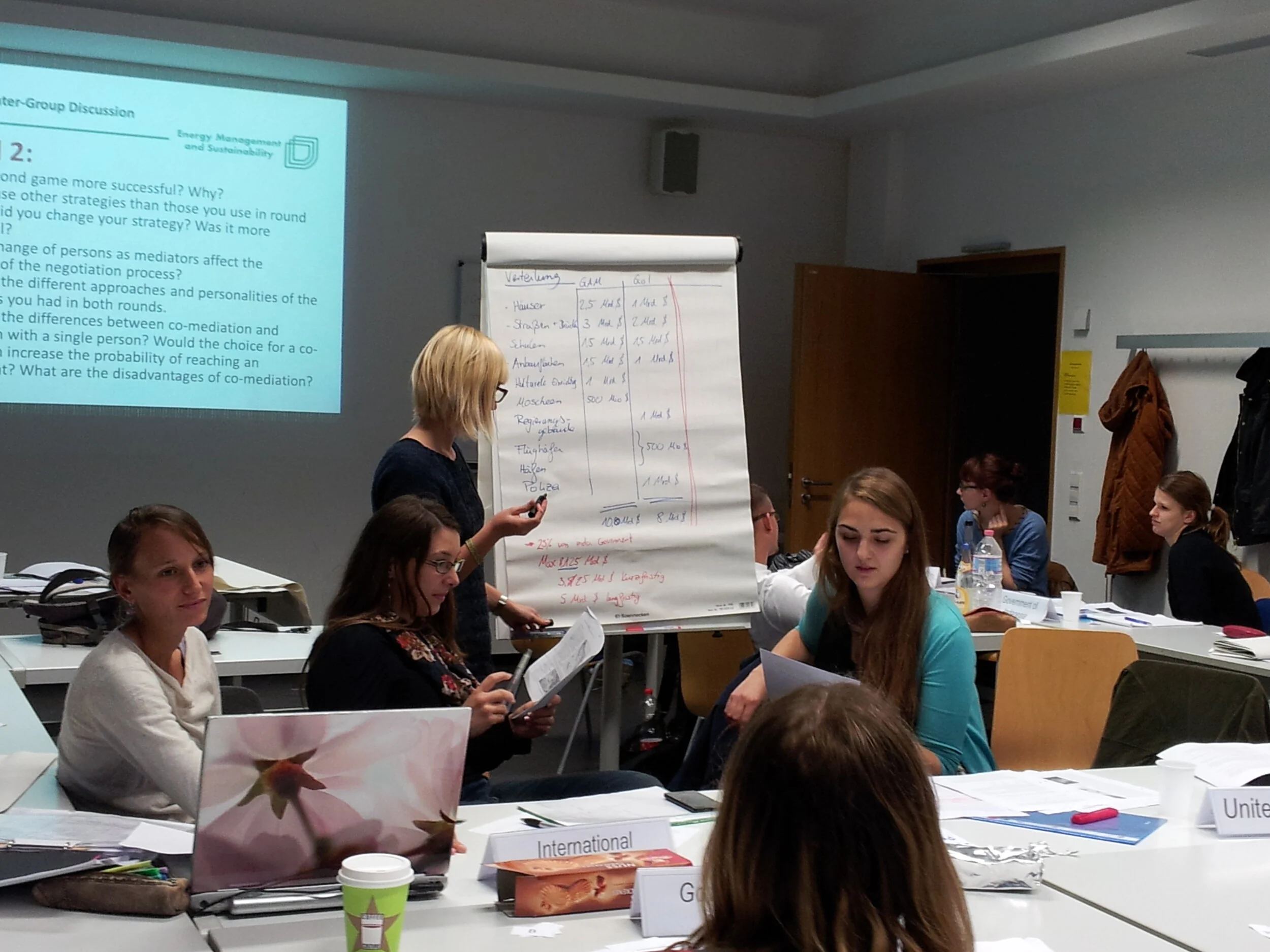
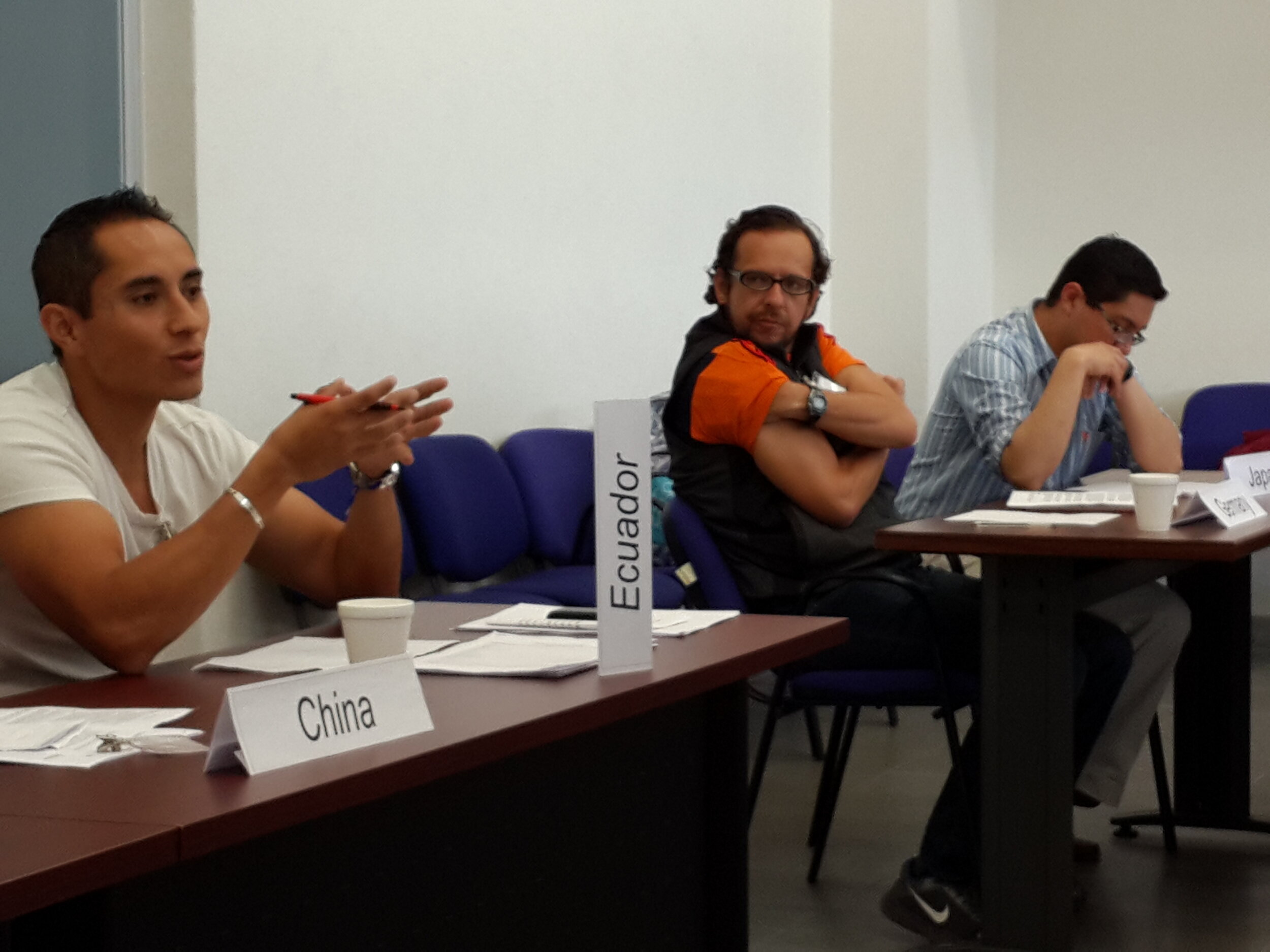
Many societal challenges cannot be understood through lectures alone. Negotiation exercises, stakeholder dialogues, policy simulations, storytelling, and case studies allow students to experience the complexity of real-world governance and decision-making.
Connecting theory and practice
Academic concepts gain meaning when applied to practical problems. My teaching therefore draws extensively on research projects, international negotiations, stakeholder engagement, and policy processes in which I have participated throughout my career.
Areas of Teaching
My courses cover a broad range of topics, including:
Sustainability transformations
International development
Global governance
Climate justice
Environmental politics
International negotiations
Conflict management
Energy policy and energy transitions
Asian rising powers
Science diplomacy
Human flourishing and sustainability
Research methods and scientific writing
International Teaching Experience
I have taught at universities in Germany, Jamaica, the Philippines, Mexico, Spain, Estonia, and other countries. These experiences have demonstrated that meaningful education requires adapting teaching methods to different cultural, institutional, and disciplinary contexts while maintaining rigorous academic standards.
Students from different regions bring different perspectives to global challenges. Encouraging dialogue across these perspectives enriches learning and prepares graduates to work in increasingly international and interdisciplinary environments.
Learning Beyond the Lecture
My courses rely heavily on active learning.
Students participate in
international negotiation simulations,
climate policy exercises,
stakeholder dialogue workshops,
role-playing games,
policy design laboratories,
storytelling,
indigenous dialogue methods,
collaborative research projects.
Many of these teaching tools have been developed specifically for my courses and are based on real policy processes, allowing students to experience the complexity of governance rather than simply reading about it.
Development of Training Tools and Simulation Games
Funding Climate Justice (2022/2024)
The Funding Climate Justice simulation immerses players in allocating resources from a fictional Climate Justice Fund to resilience projects in emerging economies. Participants, representing diverse sectors (e.g., private, local government, communities), engage in four rounds of evaluation, advocacy, and negotiation to select a winning project.
Sustainable Ideas Game – Philippine Energy System Version (2020)
Designed for 4–7 players, this board game promotes personal and community actions for sustainable energy in the Philippines. It encourages students and educators to connect ideas to concrete steps through interactive play. Players start on the “Start” square and progress through 10 boxes, each representing a vision for the energy system, such as clean or affordable energy.
Justice and the German Social and Environmental Due Diligence Law (English and German) (2024)
The simulation exercise uses storytelling to enhance empathy and understanding, focusing on how the German Supply Chain Due Diligence Act impacts the Philippine garment industry. The law requires companies to address risks like forced and child labor transparently. Participants analyze a fictional yet realistic case, examine a vulnerable character, reflect on key questions, and propose solutions, presenting recommendations for improving the law.
Jamaican Energy Vision of 2030 (2016)
This consultation simulation explores Jamaica’s path to energy security through domestic renewables, aiming for a socially, economically, and environmentally sustainable system. Stakeholders collaborate to shape the Jamaican Energy Vision 2030, defining political goals and proposing concrete measures to achieve them.
Aceh Disaster (2012)
This simulation replicates multi-stakeholder negotiations between the Indonesian government, the Free Aceh Movement, and donors, mediated by the UN Special Envoy for Tsunami Recovery. The goal is to coordinate international financial aid for Aceh’s reconstruction after the December 2004 tsunami.
Climate change negotiations (2011) (30 countries)
The UNFCCC / COP conference will be simulated. The purpose of the conference is to formulate language to a section of resolution that intends to inspire a new treaty to replace the Kyoto Protocol when it expires at the end of 2012. Because of the abbreviated nature of the panel, we will not be able to provide all of the preliminary discussions that might be useful. The game will begin mid-point in the negotiations. The agenda of the session will be mainly about commitments to reduce GHG emissions (Assigned amounts, percentages, year of level, commitment period).
North Power Line AG and the Baltic Sea Gas Pipeline (2014)
This simulation game features a bargaining table where state and non-state actors negotiate. The (fictional) Russian company Gaz Paruski and the Russian government engage in bilateral talks with European governments (Germany, Denmark, Estonia, Poland, etc.) to realize the Baltic Sea Gas Pipeline. While generally supportive, Russia prioritizes national interests. Negotiations form an interconnected network, requiring agreements at multiple levels for the project's success.
Hostage Taking (2012)
The (fictional) terrorist group "Sons and Daughters of the Sun" has kidnapped Princess Suchitra, a beloved royal figure. Negotiators have 20 minutes to secure her release through strategic negotiations.
Kick it Leipzig (2013)
This simulation involves a contract negotiation for Leon Hernandez Manzano, a talented young footballer with a migrant background, discovered by Friedrich Brandt, a respected talent scout. Leon, aspiring to join the German Bundesliga, meets with Kick it Leipzig's trainer and manager—alongside his mother and uncle—to negotiate and sign his contract.
Oceania Air (2014)
This negotiation exercise focuses on the takeover of Oceania Air by the Universal Airline Investor Consortium, led by Blacktown Bank. As a private equity investor, Blacktown Bank seeks to expand its portfolio in Australia. The deal, if successful, would mark the world’s largest airline buyout.
Six Parties COP climate negotiations (2011)
This simulation replicates a UNFCCC/COP conference, focusing on drafting a resolution section for a post-Kyoto Protocol treaty. Due to time constraints, it starts mid-negotiation. Delegates will address commitments to reduce GHG emissions, including assigned amounts, reduction targets, base years, and commitment periods.
ASEAN South China Sea Dispute Negotiations (2012)
This simulation recreates the 21st ASEAN Summit (Nov 17–20, 2012, Phnom Penh), where students represent the 10 ASEAN nations. They must navigate the complexities of structuring negotiations and reaching consensus. The goal is to draft a summit communiqué, focusing on common strategies for territorial disputes in the South China Sea, particularly the ASEAN Code of Conduct.
Spain Austerity Measures (2013)
In 2012, Spain’s cabinet met to evaluate austerity measures proposed by a government-appointed expert committee. Facing potential bankruptcy and EU/IMF intervention, the government sought spending cuts or tax increases. Failure to act risked harsher, unjustifiable measures. Cabinet members must assess options, balancing fiscal goals with social sustainability.
Taliban negotiations (2012)
This simulation game focuses on the confidential pre-negotiation phase, where conflicting parties meet informally to explore negotiation possibilities. Key uncertainties include participant eligibility, third-party mediation, and agenda-setting. Set in August 2009, the goal is to determine whether formal negotiations should begin. Each of the five parties receives confidential goals and strategic recommendations.
Current Seminar (Winter Term 2025/2026)
Global Development in the Polycrisis – Current Issues and Novel Approaches
(Globale Entwicklung in der Polykrise – Aktuelle Themen und neue Ansätze)
MA Internationale Beziehungen und Entwicklungspolitik as well as MA Development and Governance
University of Duisburg-Essen
In the face of multiple interconnected crises—collectively known as the polycrisis— critiques of international development policies are growing increasingly vocal. Critics are questioning the effectiveness of foreign aid, development assistance and development cooperation as reliable instruments for ensuring the well-being of humanity and the planet (Gabriel et al., 2022, Brand et al., 2021). The polycrisis has exposed the limitations of Western anthropocentrism and instrumentalism, which perpetuate several binaries and dichotomies inherent in the "civilizational" approach (Godrej, 2016). As a result, there is a pressing need for alternative perspectives that transcend Western-centric and purely technocratic approaches to development.
This seminar seeks to revisit, reimagine and reshape international development policies by exploring how alternative conceptions and practices can effectively the polycrisis. The seminar will achieved this aim through the following three steps:
1) Vision - Reimagining international development by incorporating bodies of knowledge beyond Western ideation, such as indigenous wisdom and non-Western development outlooks.
2) Barriers – Assessing the current limitations of international development, with a focus on power dynamics, dominance structures and path dependencies in consensual knowledge and multilateralism.
3) Actions – Developing policy recommendations for advancing international development policies
Throughout the seminar, students will enhance their critical thinking skills and deepen their understanding of diverse concepts and practices in international development. They will also learn to critically and analytically engage with international development discourse, exploring its various theoretical approaches and related practices.







Past Teaching Engagement and Thesis supervision
University Teaching
Summer 2025, Globale Entwicklungszusammenarbeit neu denken: Perspektiven für eine nachhaltige Zukunft (in German), University of Duisburg-Essen (UDE), Germany
Winter 2024/2025, Policies of International Development in the Polycrisis - Current Issues and Novel Approaches, UDE, Germany
Summer 2024, Aufstrebende Mächte Asiens in der Entwicklung und internationalen Zusammenarbeit (in German), UDE, Germany
Winter 2023/2024, Conflict and Climate Justice, University of Duisburg-Essen, Germany
Summer 2023, Asian Rising Powers in International Cooperation and Development - Chances for the 2030 Agenda?, UDE, Germany
Summer 2023, Introduction to Scientific Writing, International University of Applied Sciences, Germany
Winter 2022/2023, Conflict and Climate Justice, UDE, Germany
Summer 2022, Asian Rising Powers in International Cooperation and Development - Chances for the 2030 Agenda? UDE, Germany
Winter 2021/ 2022, Conflict and Climate Justice, UDE, Germany
Summer 2021, Asian Rising Powers in International Cooperation and Development - Chances for the 2030 Agenda?, UDE, Germany
Winter 2020/ 2021, Negotiations and Conflict Management, UDE, Germany
Summer 2020, New Global Players in International Development, UDE, Germany
Winter 2019/ 2020, Negotiations and Conflict Management, UDE, Germany
Winter 2018/ 2019, Negotiations and Conflict Management, UDE, Germany
Winter 2016/ 2017, Energy and Environmental Policies and Economics, University of Technology, Kingston, Jamaica
Summer 2016, Negotiations and Conflict Management, Faculty of Economics and Business Management, University of Leipzig
Summer 2015, Negotiations and Conflict Management, Faculty of Economics and Business Management, University of Leipzig
Winter 2014/ 2015, Negotiation (Äriläbirääkimised ja otsustamine), University of Tartu, Estonia
Summer 2014, Global Energy Politics, Faculty of Economics and Business Management, University of Leipzig
Summer 2014, Negotiations and Conflict Management, Faculty of Economics and Business Management, University of Leipzig
Winter 2013/ 2014, Climate Change, Ateneo School of Government, Ateneo de Manila University, Philippines
Winter 2013/ 2014, International Negotiations and Cooperation in Climate Change, Universidad Nacional Autónoma de México, Mexico
Winter 2013/ 2014, Sustainability assessment of the German Energiewende, Faculty of Economics and Business Management, University of Leipzig
Winter 2013/ 2014, Global Environmental and Sustainability Politics, Faculty of Economics and Business Management, University of Leipzig
Summer 2013, International Negotiations & Business, University of Alcalá de Henares, Spain
Summer 2013, Negotiations and Conflict Management, Faculty of Economics and Business Management, University of Leipzig
Winter 2012/ 2013, Sustainability assessment of the German Energiewende, Faculty of Economics and Business Management, University of Leipzig
Winter 2012/ 2013, Global Environmental and Sustainability Politics, Faculty of Economics and Business Management, University of Leipzig
Winter 2012/ 2013, International Negotiations, Institute of Political Science, University of Cologne, Germany
Summer 2012, Negotiations and Conflict Management, Faculty of Economics and Business Management, University of Leipzig
Summer 2012, International Negotiations, De la Salle University, Philippines
Summer 2012, International Negotiations, Institute of Political Science, Goethe-University, Frankfurt, Germany
Winter 2011/ 2012, International Negotiations, Institute of Political Science, University of Cologne, Germany
Summer 2011, International Negotiations, Institute of Political Science, Goethe-University, Frankfurt, Germany
2. Professional Training Programs
2023, Academic Module: Climate Justice, Managing Global Governance (MGG) Academy,
funded by the German Federal Ministry of Economic Cooperation and Development (BMZ), Germany, Post-graduate program for emerging leaders from Brazil, China, India, Indonesia, Mexico, and South Africa
2022, Academic Module: Climate Justice, MGG Academy
2022, Academic Module: Multi-actor Approaches in International Cooperation, Post-Graduate Program, German Institute of Development and Sustainability (IDOS, formerly German Development Institute), Germany
Post-graduate students from Germany and EU
2021, Academic Module: Climate Justice, MGG Academy
2021, Academic Module: Multi-actor Approaches in International Cooperation, Post-Graduate Program IDOS/BMZ
2020, Academic Module: Climate Justice (online), MGG Academy
2020, Academic Module: Multi-actor Approaches in International Cooperation, Post-Graduate Program IDOS/BMZ
2019, Academic Module: Climate Justice, MGG Academy
2019, Academic Module: Multi-actor Approaches in International Cooperation, Post-Graduate Program IDOS/BMZ
2019, Academic Module: Urban Mobility, MGG Academy
2019, Justice and Fairness in International Development Cooperation, Spring Academy, University of Bonn and IDOS, Post-graduate program for emerging leaders from Africa
2019, South-South Cooperation and Triangular Cooperation on Sustainability Standards, United Nations System Staff College, Bonn, Germany
Post-graduate program for young diplomats and UN staff members
2018, Academic Module: Climate Justice, MGG Academy
2015, Climate Change and Energy Supply Security, European Summer Academy, Friedrich-Ebert-Stiftung & Fraunhofer IMW, Germany
Summer program for young leaders from Europe
3. Thesis (Co-)Supervision
2014- 2015, Vattenfall Europe Chair for Energy Management and Sustainability, University of Leipzig, Thesis title: South Africa –its path to a more sustainable energy future –an economic perspective (Masters), First Supervisor
2012 - 2013, Vattenfall Europe Chair for Energy Management and Sustainability, University of Leipzig, Thesis title: Energy Security in Post-Fukushima: Natural Gas an Intermediate Bridge to Renewable Energies (REs)? (Masters), Second Supervisor
2012 - 2013, Vattenfall Europe Chair for Energy Management and Sustainability, University of Leipzig, Thesis title: Regulation of Natural Gas Markets in Europe (Masters), First Supervisor
2012 - 2013, Moscow State Institute of International Relations; Vattenfall Europe Chair for Energy Management and Sustainability, University of Leipzig, Thesis title: EU-Russia Energy Dialog and its Perspective until 2050 (Masters), First supervisor
2011 - 2012, Vattenfall Europe Chair for Energy Management and Sustainability, University of Leipzig, Thesis title: Kritik an der Förderung von Photovoltaikanlagen – eine differenzierte Betrachtung (Masters), Second supervisor
2011 - 2012, Vattenfall Europe Chair for Energy Management and Sustainability, University of Leipzig; Moscow State Institute of International Relations; Thesis title: International Cooperation for the Development of the Russian Arctic Region (Masters), First supervisor
2011 to 2012, Vattenfall Europe Chair for Energy Management and Sustainability, University of Leipzig, Thesis title: Ökobilanzielle Betrachtung der Reststoffströme zur Entwicklung regionaler Ökoeffizienzmaße am Beispiel des Standorts Delitzsch (Masters), Second supervisor
2011 - 2012, Vattenfall Europe Chair for Energy Management and Sustainability, University of Leipzig, Thesis title: The Development of the German Bio-Natural-Gas Market until 2020 - An Analysis of the current and future utilization potentials plus, recommendations for VNG – Verbundnetz Gas AG (Masters), Second supervisor
2011 - 2012, Vattenfall Europe Chair for Energy Management and Sustainability, University of Leipzig; Moscow State Institute of International Relations; Thesis title: Emission trading and its impact on the electricity market: implications in Germany and Russia (Masters), Second Supervisor
2011 - April 2012, Vattenfall Europe Chair for Energy Management and Sustainability, University of Leipzig, Thesis title: Wind Energy as an Option for Electrification of Rural Alaska (Masters), First Supervisor
2011 -2012, Vattenfall Europe Chair for Energy Management and Sustainability, University of Leipzig, Thesis title: Negotiation Stumbling Blocks and Environmental Governance of the Climate Talk in the Republic of Korea (Masters), First Supervisor
2011 - 2012, Vattenfall Europe Chair for Energy Management and Sustainability, University of Leipzig, Thesis title: Current Issues of Energy Policy and Security of the Energy Sector in Japan (Masters), First Supervisor
2011 - 2012, University of Utrecht, Faculty of Geosciences; Vattenfall Europe Chair for Energy Management and Sustainability, University of Leipzig, Thesis title: Explaining Dutch Failure and German Success in Renewable Energy Policymaking. An Agency/Structure Perspective (Masters), Second supervisor
